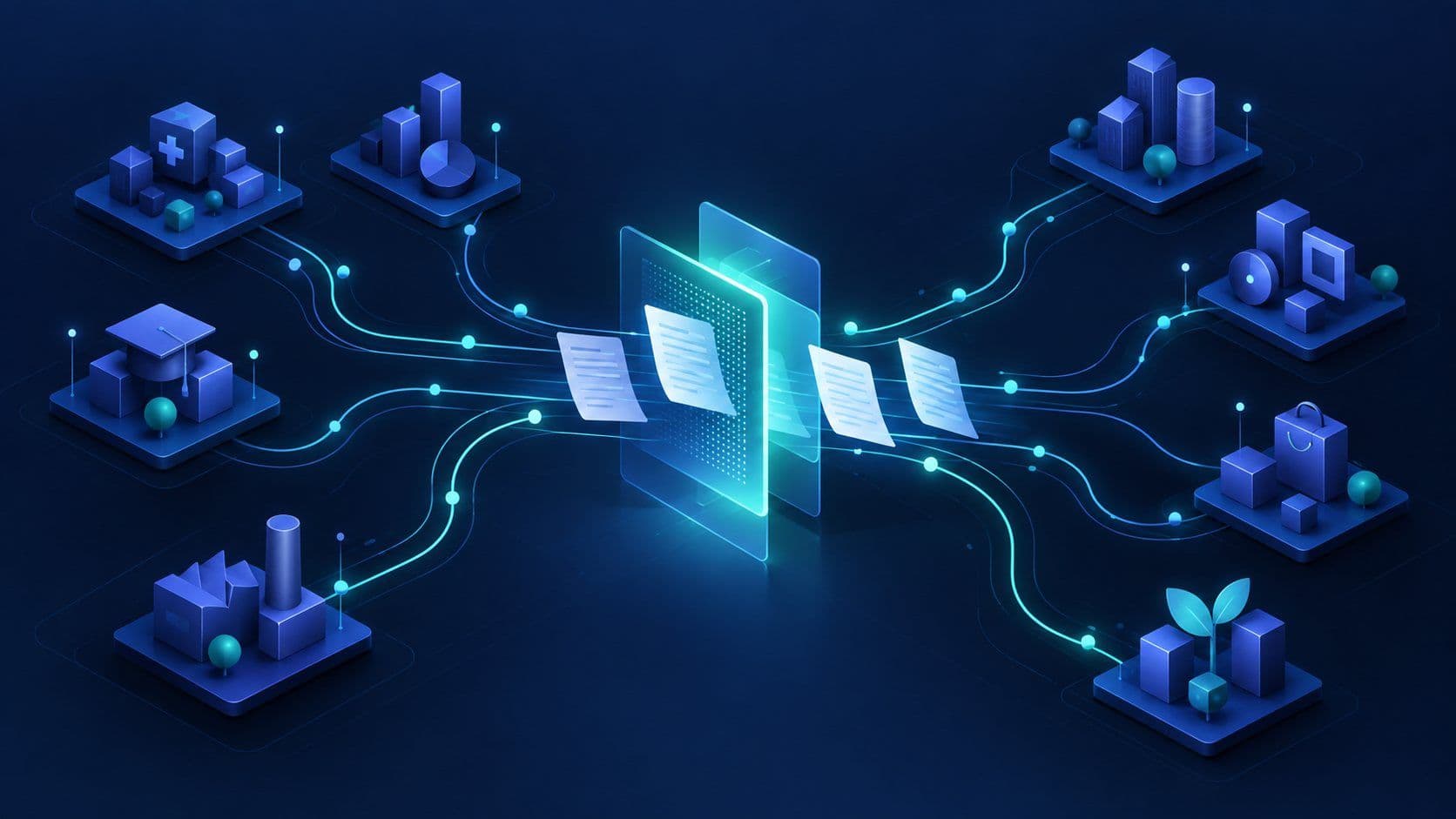
Vertical AI is best understood as AI applied to a bounded industry workflow: a tightly scoped task with clear documents, rules, and outcomes. For small-business buyers, that orientation matters more than model names. The most reliable wins come from mapping your documents and decisions, trying a focused pilot, and validating whether a tool fits your workflow, review needs, and data controls.
This guide offers a workflow-based market map, a practical evaluation checklist, build-versus-buy considerations, an example pilot scorecard, known limitations, and FAQs. It complements—rather than repeats—our introductory overview of vertical AI; if you want a primer first, see our guide on vertical AI SaaS for small businesses.
What vertical AI is (and how it works in practice)
The core pattern to look for is simple and repeatable across industries:
Input: domain documents or data (forms, statements, drawings, logs).
Extraction/Retrieval: structured fields or relevant context are pulled from those inputs.
Proposed Output: a draft calculation, summary, classification, or answer.
Human Review: a professional validates, edits, or approves the output.
System Update: the correction feeds back into the system and your records.
Treat this as a design pattern, not a guaranteed vendor feature. Some products expose every step; others wrap steps inside a single screen or API. In all cases, your pilot should verify that the tool fits your actual inputs, review process, and downstream systems.
A workflow-based market map for small businesses
Here’s a practical way to navigate vendors by the workflows they target. These examples are illustrative, not ranked recommendations, and suitability depends on your specific requirements and commercial terms.
Workflow category | Typical inputs | Proposed AI output | Where a human reviews | Example vendor fit (illustrative) |
|---|
Lending document understanding and analytics | Bank statements, pay stubs, tax forms | Parsed fields, income analyses, anomaly flags | Credit analyst or underwriter | Ocrolus — document understanding and financial analytics for lenders (accessed Oct 6, 2026) |
Legal research and contract analysis | Case law, contracts, memos | Relevant citations, clause comparisons, draft redlines | Attorney or legal ops | Harvey — legal research, document analysis, and contract intelligence (accessed Oct 6, 2026) |
Construction takeoffs and estimating | Blueprints, plan sets | Quantity takeoffs, area measurements, line items | Estimator or project manager | Togal.AI — construction takeoff tools for estimators (accessed Oct 6, 2026) |
Claims/benefits document and advice workflow (example) | Policy PDFs, claims forms, receipts | Eligibility notes, missing-info requests, draft decisions | Licensed adjuster or benefits specialist | Example category only (no specific provider asserted here) |
Professional services QA and review | Internal reports, client deliverables | Consistency checks, citation reminders, risk flags | Engagement lead or reviewer | Example category only |
Field service triage | Photos, service logs | Fault classification, parts suggestions | Technician dispatcher | Example category only |
Inventory and catalog enrichment | SKUs, vendor spec sheets | Attribute extraction, short/long descriptions | Merchandise manager | Example category only |
Compliance document prep | Procedures, audits, evidence docs | Gap summaries, draft policies | Compliance officer | Example category only |
How to use this map:
Anchor on your workflow. Describe the exact document types, decisions, and exceptions you handle each week.
Test on reality. Pilots should use your real (properly redacted or sandboxed) documents—including weird edge cases.
Size the human loop. Vertical AI shines when professionals can quickly validate or correct the model’s suggested output.
Verify ownership and operations. Confirm who maintains prompts, schemas, evals, and integrations over time.
How to evaluate a vertical AI tool
Answer these questions with concrete examples from your own process and a pilot. The goal is to turn vague “AI potential” into a clear accept/reject decision.
Representative documents and exceptions
Do you have a de-identified set of real documents that reflect seasonality, legacy formats, and bad scans?
Have you included edge cases (handwritten notes, multi-language, extra attachments, nonstandard clauses)?
Baseline manual time
Can you articulate how your team currently completes the task end to end, including context switching and checks?
Document the sequence and handoffs, not just the stopwatch time, so you can compare like-for-like later.
Total review time and correction rate
During the pilot, measure the time it takes to review the AI’s outputs and how often edits are necessary.
Track which errors matter (business-critical) versus minor edits (style, formatting).
Audit trail and source references
Can you trace each field or assertion back to a page, paragraph, or bounding box?
Is there a review log capturing who approved what and when?
Data access, retention, and deletion
Export and interoperability
Can you export structured outputs in formats your systems accept (CSV, JSON, PDFs with annotations)?
Is there an API or file-based workflow that matches how you already operate?
Maintenance ownership
Who owns schema updates when your documents change?
Who maintains prompts, evaluations, and model upgrades to avoid drift?
Total software and support cost
Beyond a license, what support, implementation, and change-management effort will you carry?
Are there minimums (seats, volume, term) that fit your scale and purchasing process?
Decision-wise:
Buy when a tool natively fits your workflow, data controls, and review needs—and you can operate it sustainably.
Customize when gaps are bounded (e.g., a few extra fields, a simple export), and ownership is clear.
Build when your workflow is sufficiently differentiated or regulated that off-the-shelf tools cannot meet your requirements without heavy workarounds.
Example pilot scorecard (fill with your data)
Use a simple scorecard to evaluate fit. These fields are illustrative; populate them with your pilot results rather than targets.
Tip: keep raw artifacts (sample inputs, model outputs, reviewer notes, and timing logs) so you can revisit decisions and train future reviewers.
Build vs. buy for vertical AI
Buy when a product already does your workflow with acceptable controls; customize when gaps are narrow and clearly owned; build when your needs are differentiated and justify ongoing maintenance.
When to buy
The vendor’s workflow, document coverage, and human-review loop match your process closely.
You can meet data residency/retention requirements and integrate exports with minimal effort.
You have a clear support path for updates to document templates or schemas.
When to customize
You need limited extensions (additional fields, minor UI changes, light integration) that a vendor or partner can implement without destabilizing your process.
You have defined who will maintain those changes as documents evolve.
When to build
Your processes are unique, regulated, or proprietary enough that off-the-shelf tools would force brittle workarounds.
You want direct control over prompts, schemas, and release timing, and you can commit to ongoing maintenance.
Implementation paths with Propelius
Proof of Concept (30 days): A time-boxed effort to validate feasibility and fit for a specific vertical workflow using your representative documents and acceptance criteria you agree up front. A POC confirms whether the approach can work; it is not a complete production MVP.
Full build (90 days): A separate engagement focused on building and hardening the production solution with agreed scope and acceptance criteria, including the review loop, exports, and operational runbooks.
No generic prices, guarantees, or outcomes are implied here. If you pursue a build, align scope with the maintenance you’re prepared to own: prompts and evals, schema updates, model and API versions, and data lifecycle.
Common limitations and how to mitigate them
Set expectations early and build guardrails into your pilot and operations.
FAQs
What makes vertical AI different from horizontal AI tools?
Vertical AI is designed around a specific industry workflow—like underwriting, estimating, or contract review—rather than generic text or image tasks. The value comes from domain coverage, document handling, and a workable human-review loop.
Are there vertical AI tools truly ready for small businesses?
Some products may fit smaller teams, but availability, minimums, and commercial terms vary. Assess fit using your documents and constraints. Do not assume SMB affordability or terms without verification.
How do I avoid over-customizing a vendor product?
What’s the quickest way to de-risk a decision?
Run a short, representative pilot with real documents, defined acceptance criteria, and a go/no-go rule. Capture total review time, correction patterns, and auditability.
Can a POC replace an MVP?
No. A POC validates feasibility for a narrow scope. A production MVP adds reliability, monitoring, data controls, and integrations needed for day-to-day use.
Do I need legal or compliance sign-off before piloting?
References
Ocrolus — document understanding and financial analytics for lenders: https://www.ocrolus.com/ (accessed Oct 6, 2026)
Harvey — legal research, document analysis, and contract intelligence: https://www.harvey.ai/ (accessed Oct 6, 2026)
Togal.AI — construction takeoff tools for estimators: https://www.togal.ai/ (accessed Oct 6, 2026)
Hustle Fund overview of vertical AI as industry-specific workflows: https://www.hustlefund.vc/post/vertical-ai-market-map (accessed Oct 6, 2026)
Ready to map your own workflow and pilot? Get in touch to explore a 30-day POC or a 90-day full build aligned to your documents, review loop, and acceptance criteria.