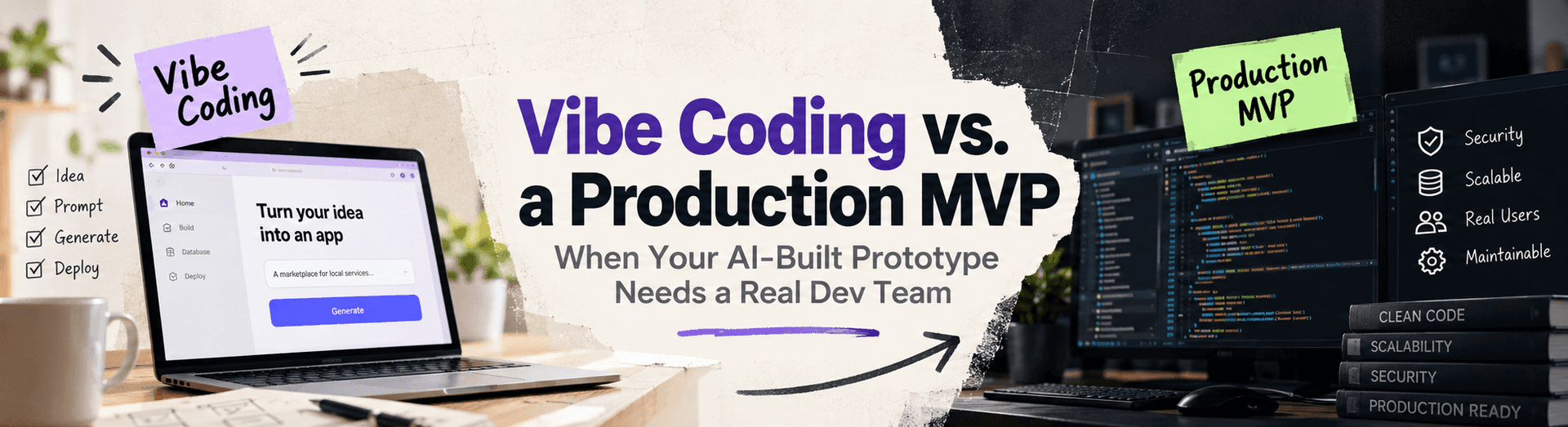
Vibe Coding vs. a Production MVP: When Your AI-Built Prototype Needs a Real Dev Team
You built a working app in a weekend with AI. Now the question is whether it can survive real users.
Vibe coding has changed how founders start products. Tools like Lovable, Bolt.new, Cursor and Claude can turn a written idea into a clickable, deployed app in days. That speed is real, and for validating an idea it is often the smartest place to begin.
The problem shows up later. A prototype that impresses in a demo can fall apart once it has to handle payments, private customer data, more than a few dozen users, or a second developer touching the code.
Here's the quick summary:
- Vibe coding is great for: validating demand, investor demos, clickable flows, internal tools and UX experiments.
- It struggles with: security, data isolation between customers, billing, performance under load and code that a team can maintain.
- The risk is measurable: Veracode found AI-generated code introduced security flaws in 45% of the coding tasks it tested.
- The switch point: once real money, real customer data or a real launch date is involved, the prototype needs production engineering.
- You rarely start from zero: the validated flows, screens and learnings from your prototype become the spec for the production build.
- Specialist help exists: a handful of companies, including Upsilon and Propelius, focus on turning AI-built prototypes into production MVPs.
Rule of thumb: Use vibe coding to find out what to build. Use engineering to make sure it keeps working.
What Vibe Coding Actually Is
The term was coined in February 2025 by AI researcher Andrej Karpathy, who described a way of building where you describe what you want, let an AI write the code, and largely stop reading it. By the end of the year, "vibe coding" was named Collins Dictionary's Word of the Year for 2025 (Wikipedia).
In practice, it looks like this:
- You describe a feature in plain language ("add a sign-up form with email and Google login").
- An AI tool generates the code, the UI, and often the database tables.
- You test it in the browser, paste back any error, and ask for a fix.
- You repeat until the app does roughly what you want, then deploy it.
For a non-technical founder, this removes the biggest early barrier: needing a developer before you can show anyone anything.
Where Vibe Coding Genuinely Works
Vibe coding is not a toy. Used for the right job, it saves weeks and a meaningful amount of money.
| Use Case |
Why Vibe Coding Fits |
| Idea validation |
You can put something real in front of 10–20 target users before spending on development |
| Investor and partner demos |
A working walkthrough lands better than slides or static mockups |
| Clickable user flows |
Fast to change while you are still learning what users expect |
| Internal tools |
Small user base, low risk, no sensitive external data |
| UX experiments |
Cheap to build two or three versions and compare reactions |
If you want to try it yourself first, Upsilon's step-by-step guide to vibe coding your MVP is one of the more practical playbooks for non-technical founders. It walks through writing a product requirements document before you prompt anything, choosing guided tools like Lovable or Bolt.new, breaking features into small prompts, and using Git as a safety net when the AI breaks something.
The key is to treat what you build as a learning tool. The goal at this stage is evidence: do people sign up, click through, come back, or ask when they can pay?
Where Vibe-Coded Apps Break
The same qualities that make vibe coding fast are what make it fragile. The AI optimizes for "it works when I click it," not for "it is safe, fast and maintainable when 5,000 people use it."
Security Is the Biggest Gap
Veracode's 2025 GenAI Code Security Report tested more than 100 large language models on 80 coding tasks and found that the generated code introduced security vulnerabilities in 45% of cases (Business Wire). Its 2026 follow-up found the overall security pass rate stuck around 56%, barely improved from the year before, even as the code became more functional (SD Times).
This is not theoretical. In 2025, a researcher scanned 1,645 apps from Lovable's public showcase and found 170 of them with database tables that anyone could read or write using only the public key shipped in the browser, because row-level security had never been switched on. The issue was logged as CVE-2025-48757 (Superblocks). Exposed data included emails, addresses and, in some cases, API keys.
The founders behind those apps were not careless. They simply never knew the setting existed, because nothing in the prompt-and-test loop told them.
The Other Common Failure Points
| Area |
What Usually Happens in a Vibe-Coded App |
Why It Matters |
| Data isolation |
One customer's data is reachable by another through a missing check |
A single leak can end trust with early customers |
| Authentication |
Login works, but sessions, password resets and roles are fragile |
Users get locked out, or get access they should not have |
| Payments and billing |
A checkout button exists, but failed payments, refunds and webhooks are not handled |
Revenue leaks quietly and support tickets pile up |
| Performance |
Fine with 10 users, slow with 500 |
Early traction stalls right when it matters |
| Maintainability |
Thousands of lines no one has read, with duplicated logic |
Every new feature breaks an old one |
| Compliance |
No audit trail, no data retention rules |
Blocks enterprise deals and regulated industries |
Many of these problems come from the same place: the AI only knows what you asked for. If you never prompted for tenant isolation, rate limiting or webhook retries, they usually are not there. Our guide to quality assurance steps for SaaS development covers what a proper testing process checks for.
5 Signs You've Outgrown Your Prototype
You do not need to rebuild the moment your prototype works. You need to rebuild when the cost of keeping it starts exceeding the cost of fixing it. Watch for these signals:
- You are about to take real payments. Billing logic needs proper error handling, webhooks and reconciliation, not just a payment button.
- You are storing other people's private data. Customer records, health details, financial information or documents uploaded by users all raise the bar for security.
- Each fix creates a new bug. When the AI's changes regularly break existing features, the codebase has become too tangled for prompting alone.
- You have a launch date or a paying pilot. A demo can fail gracefully. A paying customer's first week cannot.
- Investors or enterprise buyers are asking technical questions. Due diligence usually covers code ownership, security practices and how the product will scale.
If two or more of these apply, it is time to bring in engineers.
Rebuild, Refactor, or Keep Going?
Moving to production does not always mean throwing everything away. The right path depends on how the prototype was built and what it needs to become.
| Situation |
Best Path |
What It Looks Like |
| Still testing whether anyone wants it |
Keep vibe coding |
Stay lean, focus on user feedback, avoid real customer data |
| Core flows validated, code is reasonably structured |
Refactor |
Keep the stack, add security, tests, proper auth and billing |
| Code is tangled, insecure or tied to one AI platform |
Rebuild |
Use the prototype as a living spec and rebuild on a solid architecture |
| Heavy compliance needs (health, finance, enterprise) |
Rebuild with compliance in scope |
Plan security, audit logs and data handling from day one |
In most rebuilds, the prototype is still valuable. It answers the hardest questions in advance: which screens matter, which features users ignore, and what the core flow should feel like. That makes the production build faster and cheaper than starting from a blank page.
What a Production MVP Adds
A production MVP is still minimal. It just carries the parts a prototype skips:
- Security by default: row-level security, input validation, secrets kept on the server, dependency scanning.
- Data isolation: every customer sees only their own records, enforced in the database, not just the UI.
- Reliable auth and roles: sessions, password resets, social login and role-based permissions that hold up.
- Billing that handles edge cases: failed cards, refunds, plan changes and webhook retries.
- Testing: automated tests on core flows so new features do not quietly break old ones.
- Monitoring: error tracking and alerts, so you hear about problems before your users tell you.
- Code you own and can hand over: a readable codebase in your own repository, documented well enough for the next developer.
None of this makes the MVP bigger in features. It makes the features you already validated safe to put in front of paying customers.
Companies That Turn Vibe-Coded Prototypes Into Production MVPs
Most development agencies will happily build you an app from scratch. Far fewer have a clear process for taking over an AI-built prototype, auditing it, and hardening it for real users. If you are looking for that kind of partner, these five are worth a look:
| Company |
Best For |
Approach |
| Upsilon |
Founders who want guidance from prototype through a full MVP |
Vibe-coded prototyping plus full-cycle MVP development, with fixed-price options via Launch MVP Fast |
| Propelius Technologies |
Founders who need a production MVP fast, with costs fixed upfront |
Prototype audit, then a production build starting at 30 days |
| MetaCTO |
Funded teams with a larger AI-built codebase to stabilize |
Free 48-hour code audit, then a fixed-price rescue |
| Railsware |
Products that need deep refactoring without a full rewrite |
Audit, then incremental refactoring of the existing codebase |
| Redwerk |
Apps with security or compliance concerns |
Code review, cleanup and a dedicated security audit |
1. Upsilon
Upsilon is a product studio founded in 2012, with offices in the US and Estonia, that works with early-stage and growth-stage startups. It openly embraces vibe coding as a starting point: the team offers prototyping with vibe coding for fast validation, then carries the product forward with discovery, full-cycle MVP development, team augmentation and CTO-as-a-service. For founders who want a fixed price and full code ownership, its sister brand Launch MVP Fast builds production-ready MVPs for non-technical founders with an instant online estimate and a 30-day warranty.
Best for: founders who want one partner from the first prototype to a scalable product.
2. Propelius Technologies
Propelius is a product development company based in Surat, India, rated 5.0 on Clutch, with 120+ products shipped. We build production-ready MVPs starting at 30 days with all costs agreed upfront, and we regularly take over prototypes built with tools like Lovable, Bolt.new and Cursor. Every engagement starts with an audit of what to keep, refactor or rebuild, so the validated parts of your prototype carry forward instead of being thrown away. Our 30-day plan is outlined in the next section.
Best for: founders who need to move from prototype to paying customers quickly, on a fixed budget.
MetaCTO runs a dedicated "Vibe Rescue" service for codebases built with Cursor, Claude Code, GitHub Copilot, Lovable, v0, Bolt, Replit and similar tools. It starts with a free 48-hour code audit and a fixed-price rescue plan, then aims for production readiness, including tests, CI and monitoring, in about 30 days. Its published rescue engagements range from $50,000 to $150,000, so it suits teams with funding and a sizeable codebase.
Best for: funded startups whose AI-built product already has users and serious technical debt.
4. Railsware
Railsware is a product studio with around two decades of experience, known for building its own products such as Mailtrap and Coupler. Its Vibe Code Fixing service focuses on cleaning up architecture, technical debt and fragile logic through incremental refactoring, rather than rebuilding parts that already work.
Best for: products that have grown messy but are worth saving rather than rewriting.
5. Redwerk
Redwerk, working since 2005 with teams in Ukraine and Estonia, offers a Vibe Code Cleanup service covering code review, refactoring, performance tuning and testing, plus a separate security audit with attention to HIPAA and GDPR. For a small project, the initial assessment and critical refactoring can take one to two weeks.
Best for: apps that handle sensitive data and need a security-first cleanup.
From Prototype to Production MVP in 30 Days
When a founder comes to Propelius with a vibe-coded prototype, a typical 30-day plan looks like this:
| Week |
Focus |
Outcome |
| Week 1 |
Prototype audit and scoping |
A clear list of what to keep, refactor or rebuild, plus a fixed scope |
| Weeks 2–3 |
Core build |
Validated flows rebuilt with proper auth, data isolation and billing |
| Week 4 |
QA, security review and launch |
Tested, monitored and deployed, with the code in your repository |
You keep everything your prototype taught you. We make sure it holds up when real users, real payments and real data arrive.
If you already have a prototype, you can get a free estimate within 24 hours through a short form, no call required.
Conclusion
Vibe coding is one of the best things to happen to early-stage founders. It lets you test ideas in days instead of months and walk into conversations with something real to show.
But a prototype and a product are different things. The research is clear that AI-generated code carries real security risk, and incidents like CVE-2025-48757 show what happens when apps reach the public without anyone checking the defaults.
The smart path is to use both, in order:
- Vibe code to validate the idea and learn what users actually want.
- Watch for the switch signals: payments, private data, launch dates, or fixes that keep breaking things.
- Engineer the production version using your prototype as the blueprint, so you move fast without starting over.
FAQs
Can a vibe-coded app be used in production?
It can, but rarely as-is. Most vibe-coded apps need a security review, proper data isolation, tested authentication and billing logic before they are safe for paying customers. Small internal tools with no sensitive data are the main exception. For anything public that stores user data or handles payments, treat the AI-generated code like code from an unknown contractor: review it, test it, and fix the gaps before launch.
Is vibe coding secure?
Not by default. Veracode's 2025 research found that AI-generated code introduced security vulnerabilities in 45% of the tasks tested, and its 2026 follow-up showed little improvement. The most common issues are missing access controls, exposed keys and unvalidated input. Vibe coding can be part of a secure process, but only with human review, security scanning and deliberate configuration of things like row-level security.
Do I need to rebuild my vibe-coded MVP from scratch?
Not always. If the code is reasonably structured and the stack fits your plans, refactoring is often faster: keep what works, then add security, tests and proper auth and billing. If the code is tangled, insecure or locked into one platform, a rebuild is usually cheaper over time. Either way, your prototype stays valuable as a living specification of what users actually need.
Which companies help turn vibe-coded apps into production MVPs?
A small number of development companies offer this as a defined service. Upsilon combines vibe-coded prototyping with full-cycle MVP development and offers fixed-price builds through Launch MVP Fast. Propelius Technologies audits existing prototypes and builds production MVPs starting at 30 days with costs fixed upfront. MetaCTO, Railsware and Redwerk also run dedicated rescue or cleanup services for AI-generated codebases. The right choice depends on your budget, how much of the existing code is worth keeping, and whether you handle sensitive data.
How long does it take to turn a prototype into a production MVP?
For a focused MVP with validated core flows, it typically takes around 30 days with an experienced team: about a week to audit and scope, two weeks to build the core flows properly, and a final week for QA, security review and launch. More complex products with heavy integrations or compliance needs take longer.