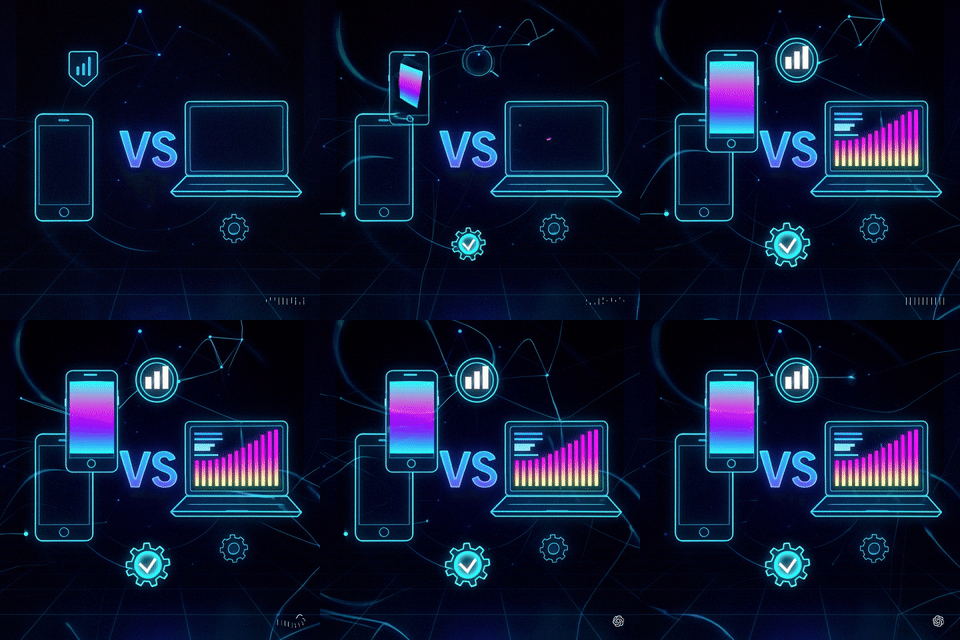
MVP vs POC vs Prototype: What Founders Actually Need to Build First
Three terms, constant confusion, real money on the line. "We need an MVP" — said by a founder who actually needs a POC. "Let's build a prototype" — said by a team that should be building a real MVP. The terminology matters because each artifact serves a different purpose, costs differently, and should drive different decisions.
Proof of Concept (POC): Does This Actually Work?
A POC answers one question: is this technically feasible?
It's not for users. It's not for investors. It's for your engineering team to validate that a specific technical approach can work before committing to it.
What a POC Validates
- Database performance: "Can we process 100K records in under 5 seconds?"
- AI capability: "Can this LLM reliably extract structured data from unstructured medical records?"
- Streaming feasibility: "Can we stream video from IoT sensors with acceptable latency over 4G?"
- Third-party API: "Does this payment provider support our custom checkout flow?"
POC code is intentionally throwaway. You're proving a hypothesis, not building a foundation. If the POC fails, you've saved months of misdirected engineering.
Time and cost: Days to a few weeks. Intentionally cheap.
Prototype: Does This Feel Right?
A prototype answers: does this experience work for users?
Prototypes are interactive mockups — they look like real products but typically have no real backend. The goal is to put something in front of users and watch them interact before a line of real product code is written.
| Type | Tool | Fidelity | Purpose |
|---|
| Paper mockup | Pen + paper | Very low | Initial concept validation |
| Wireframe | Figma/Balsamiq | Low | Navigation and layout |
| Clickable prototype | Figma/InVision | Medium | UX flow validation |
| Coded prototype | React + mock data | High | Near-real interaction testing |
When to build a prototype: Before committing to the engineering spec for any user-facing feature. Use the appropriate fidelity for the decision at hand — don't build a coded prototype when a Figma mockup answers the question.
MVP: Is Anyone Willing to Pay for This?
The MVP answers the most important question: do real users get enough value to pay or commit to this product?
The "minimum" in MVP is about scope, not quality. A buggy MVP is still an MVP — but a non-functional one that can't deliver the core value proposition isn't. The MVP must work for real users doing real tasks.
What an MVP Is
- A real, working product serving real users with real data.
- Delivers the core value proposition — one thing, done well.
- Has sufficient quality that users can evaluate whether it solves their problem.
- Used to make a go/no-go decision about the product direction.
The Most Common MVP Mistake
Building too much. Teams add features because they feel insecure about a "minimal" offering. But every additional feature before validation is an unvalidated bet. Ship the minimum that tests your core hypothesis — nothing more.
Side-by-Side Comparison
| Dimension | POC | Prototype | MVP |
|---|
| Primary question | Does it work technically? | Does the UX make sense? | Will people pay/use it? |
| Audience | Engineering team | Potential users (non-paying) | Real target users |
| Real backend | Possibly | No | Yes |
| Code quality | Low (throwaway) | Low (throwaway) | Moderate (maintainable) |
| Duration | Days–weeks | Days–2 weeks | 4–12 weeks |
| Goal | Kill bad tech bets early | Kill bad UX bets early | Validate the business model |
The Right Sequence
- User interviews — validate the problem is real and worth solving (free).
- POC — if there's a technical risk, validate it first (days).
- Prototype — validate UX and core workflow (1–2 weeks).
- MVP — build the real minimum product for real users (4–12 weeks).
- Iterate — based on real usage data, not assumptions.
Skipping steps costs money. Skip the POC and build the MVP on a flawed technical assumption → rebuild from scratch. Skip the prototype → expensive UX redesigns. Rush to MVP before problem validation → build something nobody wants.
Non-Technical Founders: What You Actually Need
Most founders who come to us asking for "an MVP" actually need one of three things:
- A demo/prototype to test with early users and raise seed funding — don't burn engineering budget yet.
- A real MVP with a paid development team — because you've already validated the problem and UX.
- A POC to evaluate a technical approach before committing a budget.
Before engaging a development team, ask: what specific hypothesis am I trying to validate? The answer tells you which artifact to build.
For more on the technical decisions in MVP development, see How to Choose the Right Tech Stack for Your MVP and 90-Day MVP Sprints: De-risking Product Launches.
FAQs
What is the difference between MVP and prototype?
A prototype is a non-functional or minimally functional demo built to validate UX and workflow — typically using design tools, shown to potential users before engineering begins. An MVP is a real, working product built for real users with real data, used to validate whether users will pay for or commit to your solution.
What is a POC in software development?
A POC (proof of concept) is a technical experiment built by the engineering team to validate that a specific technical approach is feasible before committing to it in the actual product. POC code is typically throwaway — it's not the foundation of the product. If the POC fails, it's a success: you've saved months of misdirected engineering.
How long does it take to build an MVP?
For a well-scoped MVP with a dedicated team of 3–5 engineers, 4–8 weeks is typical. Propelius' 30-day MVP sprint is designed for products with clear scope, a validated problem, and no major technical risks. Scope creep is the most common reason MVPs take longer than expected.
Should I build a POC or an MVP first?
Build a POC first only if your product depends on a non-obvious technical assumption that could invalidate the entire approach. If the technology is well-understood (standard CRUD app, common integrations), go straight to prototype and then MVP. Don't build a POC as a way to delay shipping a real product.