Most MVPs fail—not because the idea was bad, but because the execution was flawed. After working with dozens of founders on 30-day MVP sprints, we've seen the same mistakes repeat across industries, funding stages, and tech stacks. The good news: every one of them is avoidable.
This guide catalogs the 10 most common MVP launch mistakes, explains why founders make them, and provides concrete strategies to avoid each one.
Mistake 1: Building Too Many Features
The most common MVP killer. Founders confuse "minimum" with "mediocre" and compensate by adding features. What starts as a 4-week build becomes a 4-month project that still hasn't shipped.
Why it happens: Fear that users won't see value without feature X. Competitive anxiety ("but Competitor has this"). Stakeholder requests accumulating without prioritization.
How to avoid it:
One-sentence test: If you can't describe your MVP's core value in one sentence, you're building too much.
Feature budget: Set a hard limit. Three core features maximum for V1.
MoSCoW method: Categorize every feature as Must-have, Should-have, Could-have, or Won't-have. Only build the Must-haves.
Priority
Category
Rule
Must-have
Core value prop
Without this, the product doesn't solve the problem
Should-have
Important but not critical
Build in V1.1 after launch
Could-have
Nice to have
Build if time permits (it won't)
Won't-have
Out of scope
Explicitly parked for later
MVP feature prioritization framework
Mistake 2: Skipping Market Validation
Building first, validating later. Some founders spend months coding before talking to a single potential customer.
Why it happens: Building feels productive. Talking to customers feels uncomfortable. Technical founders default to what they know—code.
How to avoid it:
Talk to 20 people before writing a line of code. Not friends and family—actual potential users.
Pre-sell: Can you get 5 people to pay a deposit before the product exists? If not, reconsider the problem.
Landing page test: Build a landing page describing your product, run $200 in ads, measure sign-up conversion. Below 3%? Reposition.
Mistake 3: Over-Engineering the Tech Stack
Choosing Kubernetes, microservices, and a polyglot architecture for a product that has zero users.
Why it happens: Engineers optimize for scale they don't have. "We'll need this when we hit 1M users" — you won't hit 1M users if you never launch.
How to avoid it:
Monolith first: A well-structured monolith handles more traffic than 99% of MVPs will ever see.
Boring technology: PostgreSQL, Next.js, a single server. You can always add complexity later.
Rule of thumb: If your tech stack takes more than one paragraph to explain, simplify it.
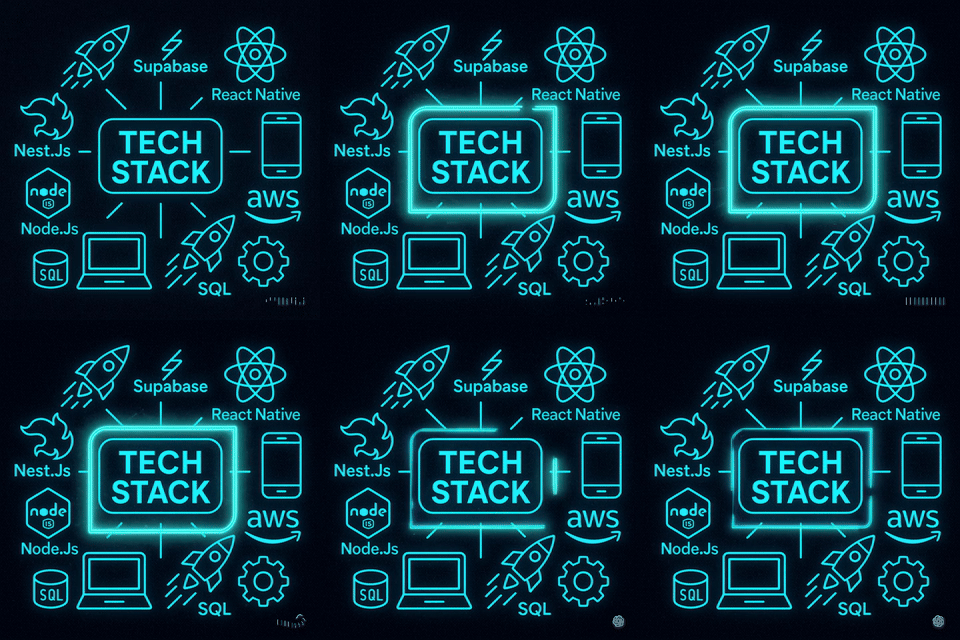
MVP Tech Stack (recommended):
├── Frontend: Next.js or React
├── Backend: Node.js or Python (Django/FastAPI)
├── Database: PostgreSQL (via Supabase or RDS)
├── Auth: Clerk, Auth0, or Supabase Auth
├── Hosting: Vercel + Railway or Render
├── Payments: Stripe
└── Analytics: PostHog or Mixpanel
Total monthly cost: $20-50
Mistake 4: Launching Without Analytics
Shipping a product with no way to measure what users actually do. You're flying blind.
Why it happens: Analytics feels like a "nice to have" when you're rushing to launch. It gets deprioritized behind features.
How to avoid it:
Day-one instrumentation: Add analytics before launch, not after. At minimum: page views, sign-ups, core action completion, and errors.
Define your north star metric: What single number tells you if the MVP is working? Track it from day one.
Event tracking > page tracking: You don't just need to know users visited the dashboard—you need to know they completed the core workflow.
MVP analytics setup
Mistake 5: Waiting for Perfection
Polishing the UI, fixing edge cases, adding one more feature—anything to avoid the uncomfortable moment of showing your work to real users.
"If you're not embarrassed by the first version of your product, you've launched too late." – Reid Hoffman
How to avoid it:
Set a hard launch date and commit publicly. Tell your audience, advisors, or investors. Social pressure works.
Define "done enough": Core workflow works, basic error handling, decent mobile experience. That's it.
Accept technical debt: You will refactor later. That's not a bug—it's the plan.
Mistake 6: Launching to the Wrong Audience
Blasting your MVP to ProductHunt, HackerNews, and every subreddit simultaneously. You get a traffic spike, zero retention, and discouraging feedback from people who were never your target customer.
How to avoid it:
Start with 10 warm leads: People who told you they have the problem your MVP solves. Onboard them personally.
Focus on one channel: Where do your target users already hang out? Go there. Ignore everywhere else for now.
Closed beta first: Invite-only creates urgency and lets you control the experience.
Mistake 7: Not Collecting User Feedback
Launching and then... waiting. No feedback mechanism, no user interviews, no way to know what's working.
How to avoid it:
In-app feedback widget: A simple "Was this helpful? Yes/No" or a feedback button on every page.
Schedule 5 user calls per week in the first month after launch. Watch them use the product (screen share). You'll learn more in 30 minutes than from 1,000 analytics events.
Track the questions: What do users ask in support? Those questions reveal what's confusing or missing.
Mistake 8: Launching Free Without a Monetization Plan
"We'll figure out pricing later" is the startup equivalent of "we'll fix it in post." Free users behave differently from paying users. Their feedback is less actionable, their commitment is lower, and they create support burden without revenue.
How to avoid it:
Charge from day one, even if it's $9/month. Willingness to pay is the strongest validation signal.
Free trial, not free tier: 14-day trial converts better than freemium for most B2B MVPs.
If you must be free: Have a clear plan for when and how you'll monetize. Write it down.
MVP pricing strategy
Mistake 9: Zero Pre-Launch Marketing
Building in stealth for months, then launching to an audience of zero. "Build it and they will come" hasn't been true since 1999.
How to avoid it:
Build in public: Share your progress on Twitter/X, LinkedIn, or IndieHackers. You'll build an audience before launch.
Waitlist: Collect emails from interested users during development. Launch to a warm audience.
Content marketing: Write 3-5 blog posts about the problem your product solves. SEO takes time—start before launch.
Mistake 10: Trying to Do Everything Solo
Non-technical founders spending 6 months learning to code. Technical founders spending 6 months on design. Both spending too long on things outside their expertise.
How to avoid it:
Find a co-founder or partner who complements your skills.
Use a development partner: A 30-day MVP sprint with an experienced team gets you to market faster than 6 months of solo development.
Focus on your unfair advantage: If you're the domain expert, spend your time on customer development and positioning. Let specialists handle the code.
MVP Launch Readiness Checklist
Category
Check
Status
Product
Core workflow works end-to-end
☐
Product
Basic error handling and loading states
☐
Product
Mobile-responsive
☐
Analytics
Event tracking on core actions
☐
Analytics
Error monitoring (Sentry or similar)
☐
Marketing
Landing page with clear value prop
☐
Marketing
10+ warm leads ready for onboarding
☐
Feedback
In-app feedback mechanism
☐
Feedback
5 user interview slots scheduled
☐
Business
Pricing page live
☐
Business
Payment integration working
☐
Legal
Privacy policy and ToS
☐
FAQs
How many features should an MVP have?
Three or fewer core features. An MVP should solve one problem well. Each additional feature adds development time, testing burden, and cognitive load for users. If you can't prioritize, use the "one-sentence test": your product's value should be describable in one sentence. Features that don't serve that sentence don't belong in V1.
How long should it take to build an MVP?
Four to eight weeks for most software MVPs. If it's taking longer than 12 weeks, you're likely over-building. At Propelius Technologies, we run 30-day MVP sprints with guaranteed delivery. The time constraint forces ruthless prioritization, which is exactly what an MVP needs.
Should I charge users from day one?
Yes, in most cases. Charging validates demand—willingness to pay is the strongest signal that your product solves a real problem. Start low ($9-29/month for B2B SaaS) and adjust based on feedback. If you must offer a free option, use a time-limited trial (14 days) rather than a permanent free tier.
When should I pivot vs. iterate on my MVP?
Iterate if users engage but want improvements (feature requests, workflow tweaks). Pivot if users don't engage at all despite trying different positioning and channels. Give your MVP at least 4-6 weeks of active user acquisition before deciding. Low sign-ups might be a marketing problem, not a product problem.
Need an expert team to provide digital solutions for your business?