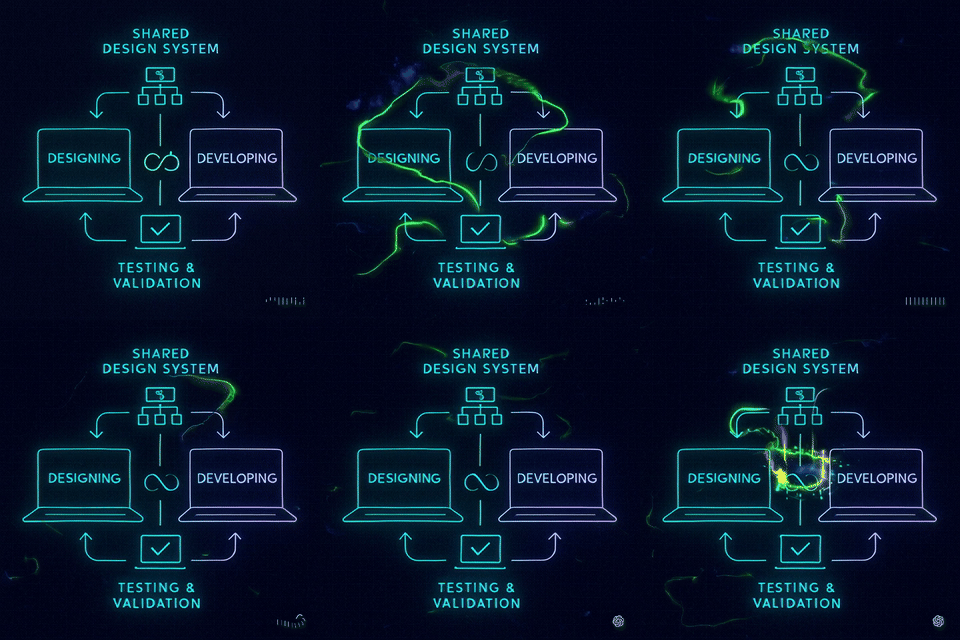






Tenant Data Isolation: Patterns and Anti-Patterns
Explore effective patterns and pitfalls of tenant data isolation in multi-tenant systems to enhance security and compliance.
Jul 30, 2025
Read More
Pricing is the most powerful lever in your SaaS business. Change it by 10%, and your revenue changes by 10% — instantly. Yet most SaaS founders spend more time perfecting their product than perfecting their pricing. The choice between usage-based and tiered pricing isn't just about numbers. It's about psychology, customer behavior, and long-term business model sustainability.
In this guide, we'll break down both pricing models, analyze their psychological impact on buyers, and help you choose the right approach for your SaaS product.
Tiered pricing (also called good-better-best) is the most common SaaS pricing model. You offer 3-4 plans at fixed monthly prices, each with different feature sets and usage limits.
Example: Project management SaaS
1. Anchoring effect: The highest-priced tier makes the middle tier look reasonable. Most customers choose the middle option (Professional) because it feels like the "smart choice" between cheap and expensive.
2. Decoy pricing: The Starter plan exists primarily to make Professional look attractive. Many customers who would have chosen Starter see Professional's value and upgrade.
3. Upgrade path: Clear progression encourages customers to grow with you. "When we hit 15 users, we'll upgrade to Professional."
4. Predictability: Fixed monthly cost makes budgeting easy. Finance teams love predictable expenses.
Usage-based pricing (also called consumption pricing) charges customers based on how much they use your product. No tiers, no feature gates — you pay for what you consume.
Example: API platform
Popular examples: Stripe (payment volume), AWS (compute hours), Twilio (API calls), Snowflake (data processed).
1. Zero-friction adoption: No need to choose a plan or commit to a monthly fee. Just start using it, pay only for usage. This dramatically reduces signup friction.
2. Fairness perception: Customers feel they're only paying for value received. "I pay when I get value" feels fairer than "I pay $99 whether I use it or not."
3. Natural expansion: As customer usage grows, revenue grows automatically. No sales intervention needed.
4. Lower risk: If a customer's business shrinks, their bill shrinks too. They're less likely to churn during slow periods.
| Metric | Tiered Pricing | Usage-Based Pricing |
|---|---|---|
| Revenue predictability | High (fixed MRR) | Variable (fluctuates with usage) |
| Trial-to-paid conversion | 15-25% | 25-40% (lower friction) |
| Expansion revenue | Requires sales intervention | Automatic (usage grows) |
| Churn during downturns | Higher (fixed cost burden) | Lower (bill shrinks naturally) |
| Average deal size | Capped by tier limits | Unlimited growth potential |
Key insight: OpenView Partners' 2024 SaaS Pricing Benchmarks found that usage-based pricing companies grow 38% faster than tiered pricing companies. However, they also experience 15% higher revenue volatility.

Many modern SaaS products combine both models:
Base + Usage
Example: Vercel
This gives you:
Choose tiered pricing if:
Choose usage-based pricing if:
Changing pricing models is painful but sometimes necessary. If you're switching:
Usage-based pricing typically sees 25-40% trial conversion vs 15-25% for tiered pricing. The reason: lower commitment friction. Customers don't have to choose a plan or commit to monthly fees. However, tiered pricing often has higher initial ACV because customers pre-commit to a monthly amount.
Legally, yes (if your ToS allows it). Practically, you should grandfather existing customers for 6-12 months and give 90 days notice. Forcing immediate price changes creates churn and damages trust. Better to apply new pricing only to new customers and upsells.
Implement usage alerts (email when you hit 50%, 80%, 100% of your average monthly usage), set optional spending caps, provide real-time usage dashboards, and offer commitment discounts for customers who want predictability (e.g., commit to $500/month usage, get 15% off).
Show both, but default to annual with "save 20%" messaging. Annual prepayment improves cash flow and reduces churn. However, monthly is easier to test for new customers. Many SaaS products start customers on monthly and offer annual after they've seen value (month 3-6).
Three is optimal for most B2B SaaS. Two tiers lack the anchoring effect. Four or more create choice paralysis. Exception: If you serve SMB, mid-market, and enterprise segments, you might need four tiers to match buyer personas.
Need an expert team to provide digital solutions for your business?
Book A Free CallDive into a wealth of knowledge with our unique articles and resources. Stay informed about the latest trends and best practices in the tech industry.
View All articlesTell us about your vision. We'll respond within 24 hours with a free AI-powered estimate.

You bring the vision. We handle the build.




© 2026 Propelius Technologies. All rights reserved.