Managing Distributed Development Teams: The 2026 Playbook
Feb 25, 2026
7 min read
Managing Distributed Development Teams: The 2026 Playbook
Distributed teams are the default now. Your Android dev is in India, your designer in Portugal, your PM in Austin. The companies winning with remote teams aren't just tolerating distance — they're optimizing for it. This means rethinking communication, coordination, and culture from first principles.
This guide covers proven patterns for managing distributed development teams at scale.
Async-First Communication
Synchronous meetings don't scale across 8+ timezones. Async communication is the only way forward.
Core Principles
Default to writing: Document decisions, don't just discuss them
No meetings for status updates: Use standups in Slack/Linear
Record meetings: Loom/Zoom recordings for those who can't attend
Clear expectations: "Reply within 24 hours" not "ASAP"
Photo by Tiger Lily on Pexels
Tool Stack for Async Teams
Category
Tool
Use Case
Written updates
Slack, Notion, Linear
Daily standups, sprint planning
Design feedback
Figma, Loom
Screen recordings with annotations
Code review
GitHub, GitLab
PR comments, CI/CD status
Documentation
Notion, Confluence
Architecture decisions, runbooks
Recordings
Loom, Zoom
Design walkthroughs, demos
Timezone Coordination Strategies
Overlap Hours
Identify 2-4 hour windows where most team members can be online:
US + India: 8-10 AM EST = 5:30-7:30 PM IST
US + Europe: 9-11 AM EST = 2-4 PM GMT
Europe + Asia: 9-11 AM GMT = 2:30-4:30 PM IST
Reserve these hours for:
Sprint planning (bi-weekly)
Critical bug triage
Architecture discussions
1-on-1s (rotate times to share pain)
Follow-the-Sun Development
Design workflows so work continues 24/7:
US team (9 AM - 5 PM EST): Writes code, opens PRs
India team (9 AM - 5 PM IST): Reviews PRs, fixes bugs, writes tests
Europe team (9 AM - 5 PM GMT): QA testing, documentation, deployment
Result: Work never stops; issues get resolved in <24 hours.
Photo by Markus Winkler on Pexels
Productivity Tracking (Without Surveillance)
Trust, but verify. Track output, not hours.
What to Measure
Velocity: Story points completed per sprint
Cycle time: Average time from PR open to merge
Deployment frequency: How often code ships to production
Bug rate: Issues created vs resolved
Review turnaround: Time to review PRs
What NOT to Measure
❌ Lines of code written
❌ Hours logged (meaningless for knowledge work)
❌ Keyboard activity tracking (kills trust)
❌ Screenshots every 5 minutes (toxic)
Rule: If a metric can be gamed, people will game it. Focus on outcomes (features shipped, bugs fixed), not activity.
Communication Norms
Written Communication Standards
1. Context-Rich Messages
Bad: "Can we talk?" (vague, anxiety-inducing)
Good: "Need 15 min to discuss API rate limit strategy. Can we sync tomorrow 9 AM EST? Agenda: [link]"
2. Decision Documentation
After every key decision, write:
What was decided
Why we chose it (alternatives considered)
Who approved
Next steps
Template: Architecture Decision Records (ADRs).
3. Pull Request Descriptions
PRs should explain:
What changed (summary)
Why (linked issue)
How to test (steps)
Screenshots/videos (for UI changes)
Video Communication Best Practices
Camera on: Builds trust (but don't mandate for all calls)
Record everything: Send recording + transcript to team
Set agenda: No agenda = no meeting
5-minute rule: Can this be a Loom instead?
Onboarding Remote Developers
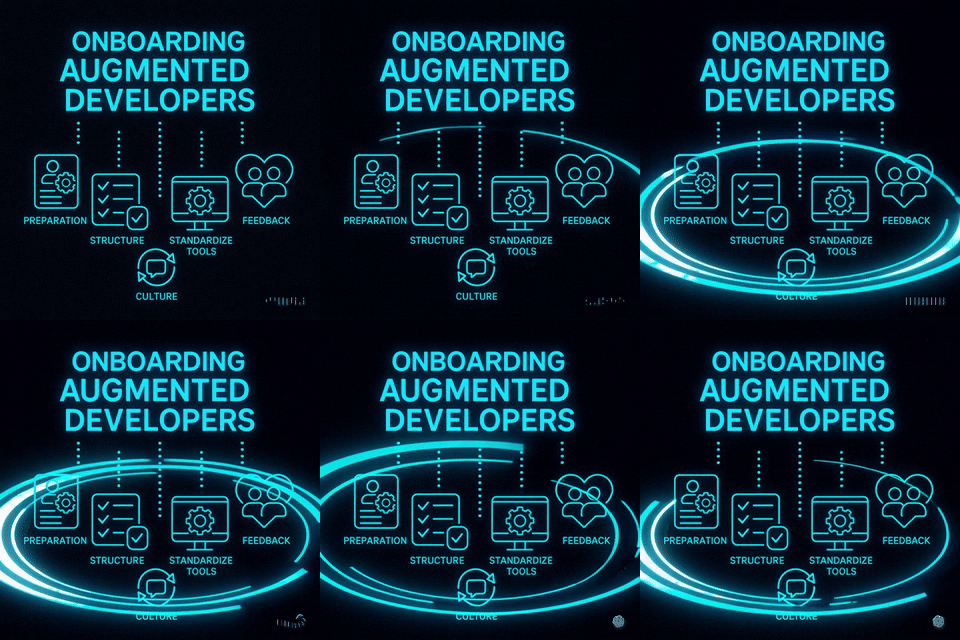
Week 1 Checklist
[ ] Local dev environment setup (automated script)
[ ] Access to all tools (GitHub, Slack, Figma, Notion)
[ ] Intro call with each team member (15 min)
[ ] Read architecture docs (2-3 hours)
[ ] Ship first PR (tiny bug fix or docs update)
Goal: First commit merged by end of day 2.
Buddy System
Assign a "buddy" (not their manager) for first month:
Daily 15-min sync for first week
Answers "dumb questions" without judgment
Pair programming on first few tasks
Photo by Markus Winkler on Pexels
Building Culture Remotely
Virtual Rituals
Monthly all-hands: 30 min, demos + wins + roadmap
Demo Fridays: Anyone can show what they built
Donut chats: Random pairing for 15-min coffee chats
Async shoutouts: #wins channel for celebrating
In-Person Offsites
Bring the team together 1-2x per year:
Team building (escape rooms, dinners)
Strategic planning (roadmap alignment)
Workshops (architecture reviews, retros)
Budget: $2K-5K per person per offsite. Worth it for cohesion.
FAQs
How many meetings should a distributed team have?
Target: <10 hours/week for ICs, <15 hours for managers. Required meetings: sprint planning (1h bi-weekly), retros (1h bi-weekly), 1-on-1s (30 min weekly), all-hands (30 min monthly). Everything else should be async or optional. Use "office hours" (2h blocks where PM/TL is available) instead of ad-hoc interruptions.
How do you ensure fairness across timezones?
Rotate meeting times so no single timezone always suffers. Alternate: US-friendly (9 AM EST) one week, Asia-friendly (9 AM IST) next week. Record all meetings and share notes. Give timezone-disadvantaged devs first pick on high-impact projects. Avoid "US HQ decides everything" syndrome — distribute decision-making authority.
How do you build trust with developers you've never met in person?
Ship things together. Trust forms through collaboration, not Zoom happy hours. Pair program on first few tasks. Over-communicate early (daily updates, frequent checkins), then relax as trust builds. Use video calls for 1-on-1s (seeing faces matters). Assume good intent when messages feel curt (text lacks tone). Visit in person if possible within first 3 months.
How do you handle performance issues with remote developers?
Same as in-person, but faster feedback loops. Document expectations clearly ("Ship 2-3 PRs per week, review PRs within 24h"). Track metrics (velocity, cycle time, bug rate). Address issues in 1-on-1s within one sprint of noticing. Create performance improvement plan (PIP) if no progress after 1 month. Remote makes it easier to spot low performers (output is visible), but harder to coach (no hallway conversations).
Should you hire contractors or employees for distributed teams?
Start with contractors (faster to hire, easier to scale up/down). Convert to employees after 3-6 months if: (1) they're critical to the team, (2) you have steady work for them, (3) you want long-term retention. Contractors work for projects; employees work for products. Use Employer of Record (EOR) services (Deel, Remote.com) to hire employees in 100+ countries without setting up entities.
Need an expert team to provide digital solutions for your business?