SaaS Observability Stack 2026: Logging, Monitoring & Alerting
The observability landscape in 2026 is shifting toward unified, all-in-one platforms that consolidate metrics, logs, and traces into single systems, moving away from fragmented tool stacks that create data silos and rising infrastructure costs. According to Splunk's State of Observability report, 83% of organizations say unified observability reduces mean time to resolution (MTTR).
Why Unified Observability Matters
Siloed monitoring tools slow incident response. When your metrics live in Prometheus, logs in Elasticsearch, and traces in Jaeger, correlating a spike in latency with a specific error log requires manual context-switching across three dashboards. Research from Google's DORA reports shows elite teams deploy 973 times more frequently than low performers when observability data connects to system reliability and user behavior.
Unified platforms enable native cross-signal correlation and one query language. Instead of learning PromQL, Lucene, and custom trace query languages, your team writes one query that joins metrics, logs, and traces automatically.
Core Observability Best Practices
Define Clear Observability Goals Aligned with Business Outcomes
Engineering teams must focus on key performance indicators such as:
- Latency: P50, P95, P99 response times
- Error Rate: 4xx and 5xx percentages by endpoint
- Throughput: Requests per second, transactions per minute
- Resource Utilization: CPU, memory, disk I/O across services
Connect these metrics to business KPIs. If checkout latency increases 200ms, how does that impact conversion rate? McKinsey reports that organizations with mature observability reduce downtime costs by up to 50%, while poor observability maturity can increase downtime costs by up to 40%.
Integrate Observability Early in Development
Observability should be embedded in continuous integration pipelines rather than added as an afterthought. Include:
- Structured logging: JSON logs with trace IDs, user IDs, request IDs
- Auto-instrumentation: OpenTelemetry SDKs injected at build time
- Synthetic monitoring: Pre-production smoke tests measuring latency budgets
- SLO tracking: Service Level Objectives defined in code, validated in CI
Leverage AI-Powered Analysis
All major platforms are integrating AI for:
- Automatic anomaly detection: Baseline learning + alerting on deviations
- Root cause analysis: Correlation engines identifying likely failure points
- Alert correlation: Grouping related alerts to reduce noise
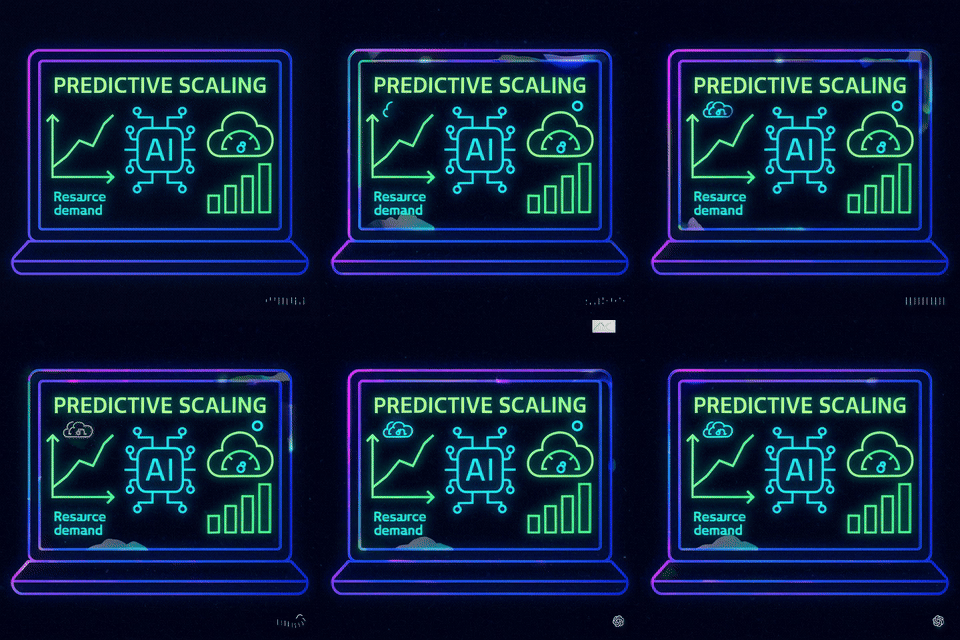
- Predictive scaling: Forecasting capacity needs before incidents
Gartner predicts that by 2027, 40% of organizations will adopt AI-driven observability solutions.
Prioritize Cost Optimization
Observability costs reach 10-30% of cloud spend for some organizations. Strategies to control costs:
- Sampling: Head-based or tail-based sampling for high-volume traces
- Log level filtering: Exclude DEBUG logs in production, keep WARN/ERROR
- Metric cardinality control: Limit label dimensions on Prometheus metrics
- Object storage integration: Archive cold logs to S3/GCS instead of hot indexes
| Feature |
Datadog |
Grafana Stack |
Unified Alternatives |
| Architecture |
Full-stack SaaS with AI-powered analysis |
Composable best-of-breed components |
Single unified backend (SigNoz, OpenObserve) |
| Integration Depth |
750+ integrations; strong in Kubernetes and multi-cloud |
Best for existing Prometheus/Grafana investment |
Limited integrations but simpler operations |
| Cost Model |
~$15-40/host/month + logs/indexed data |
Flexible; depends on component choices |
Lower TCO with self-hosted options |
| Best For |
Teams wanting polished alerting and rapid debugging |
Teams with DevOps expertise and best-of-breed preferences |
Teams prioritizing operational simplicity and cost control |
Datadog: Fastest Path to Production
Datadog stands out as the fastest path to production observability with full-stack coverage across metrics, logs, traces, RUM, and synthetics. Its correlation workflows let you jump from dashboard spikes to traces to logs seamlessly. Alerts are highly configurable with multi-condition logic, anomaly detection, and forecast-based triggers.
Drawbacks: Complex consumption model with multiple SKUs. Costs can escalate quickly with custom metrics, indexed spans, and log retention. For startups, a $500/month estimate can balloon to $5,000/month as traffic scales.
Grafana Stack: Best-of-Breed Flexibility
Grafana Stack remains optimal for organizations with strong existing Prometheus investments and teams comfortable managing component complexity. The stack typically includes:
- Prometheus for metrics
- Loki for logs
- Tempo for traces
- Grafana for visualization
Flexibility to swap individual tools and leverage best-of-breed solutions is a key advantage. However, operational overhead increases—each component needs HA configuration, backup strategies, and version compatibility management.
Unified Alternatives: Simplicity at Lower Cost
Platforms like SigNoz and OpenObserve reduce operational complexity with single backends and native correlation. They're built on OpenTelemetry standards, avoiding vendor lock-in. Cost savings come from self-hosting control and simpler licensing.
Caution: OpenObserve is early-stage and should be approached cautiously for critical production systems. SigNoz has stronger community adoption and enterprise support options.
Implementation Patterns
Full Open-Source (Self-Hosted)
Architecture: Applications → OTel Collector → SigNoz/OpenObserve → Dashboards
Pros: Maximum control, minimize direct costs
Cons: Requires infrastructure expertise for HA, backups, and scaling
Managed Open Source
Architecture: Applications → OTel Collector → SigNoz Cloud / Grafana Cloud
Pros: Combines open standards with managed operations
Cons: Usage-based costs can scale unexpectedly; less control than self-hosted
Fully Managed SaaS
Architecture: Applications → Datadog Agent / New Relic Agent → Platform SaaS
Pros: Zero operational overhead, fastest time-to-value
Cons: Highest cost, vendor lock-in on proprietary agents/query languages
Essential Stack Components
A production SaaS observability stack should include:
- Centralized Application Performance Monitoring (APM): Distributed tracing across microservices
- Centralized Logging: Aggregating errors across services with structured search
- Real-Time Alerting: Slack/PagerDuty integration with alert routing by severity
- Immutable Audit Logging: Compliance-focused logs for GDPR/SOC2
- Load Testing Integration: Simulate multi-tenant concurrency, validate SLOs
- AI Observability Tools: LLM cost and latency tracking (if applicable)
Recommendations by Team Size
| Team Size |
Recommendation |
Rationale |
| 1-5 devs |
Datadog or Grafana Cloud |
Minimal ops overhead; free tiers available |
| 6-20 devs |
SigNoz Cloud or Datadog |
Balance cost and features; team can handle some config |
| 20+ devs |
Self-hosted Grafana Stack or SigNoz |
Justify dedicated DevOps; cost savings at scale |
FAQs
Should I use a unified platform or best-of-breed tools?
Unified platforms reduce MTTR by eliminating context-switching and enable faster correlation. Best-of-breed tools offer flexibility but increase operational complexity. Choose unified for smaller teams; best-of-breed if you have dedicated SREs and specific tool preferences.
How do I control observability costs at scale?
Implement sampling (head-based for uniform traffic, tail-based for error-focused retention), filter logs by level (exclude DEBUG in production), control metric cardinality, and use object storage for cold data. Monitor your observability spend monthly and set budget alerts.
Is OpenTelemetry production-ready in 2026?
Yes. OpenTelemetry reached GA for traces and metrics in 2021-2022, and logs in 2023. Major vendors (Datadog, New Relic, Grafana, SigNoz) support OTel natively. Using OTel avoids vendor lock-in and future-proofs your instrumentation.
What AI-powered features matter most?
Anomaly detection (baseline learning + alerting), root cause analysis (correlating failures across services), alert correlation (reducing noise by grouping related alerts), and predictive capacity planning. Avoid AI features that add complexity without measurable MTTR reduction.
How long does migrating observability platforms take?
For small teams (5-10 services), 2-4 weeks. For large systems (50+ microservices), 2-3 months. Use parallel instrumentation—run old and new platforms simultaneously, validate data accuracy, then cut over service by service.
Looking to build a SaaS platform with production-grade observability from day one? Propelius Technologies delivers 30-day MVP sprints with monitoring, logging, and alerting built in. Our team has shipped 650+ web apps with enterprise-grade reliability for global clients.